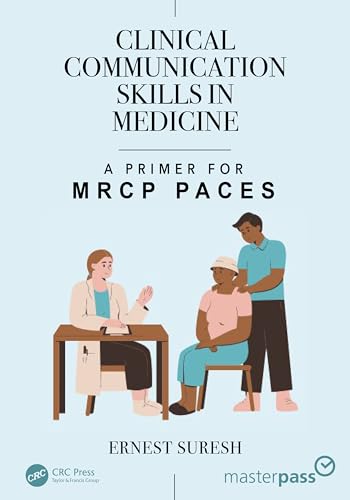
Clinical communication skills in medicine : a primer for MRCP PACES / Ernest Suresh MD, FRCP (London).
Series: Master passPublisher: Boca Raton, FL : CRC Press, Taylor & Francis Group, 2025Copyright date: ♭2025Edition: First editionDescription: viii, 238 pagesContent type:- text
- computer
- online resource
- 9781032875668
- 610.1/4 23/eng/20240919
- R 118
- WB 18.2
| Item type | Current library | Call number | Status | Date due | Barcode | Item holds | |
|---|---|---|---|---|---|---|---|
 Books
Books
|
NILE UNIVERSITY OF NIGERIA - MAIN LIBRARY | R 118 S87 2025 (Browse shelf(Opens below)) | Available | 0199242 | |||
|
Books
|
NILE UNIVERSITY OF NIGERIA - MAIN LIBRARY | R 118 S87 2025 (Browse shelf(Opens below)) | Available | 0199241 |
Includes bibliographical references and index.
Includes bibliographical references and index.
"This book takes readers through forty-five challenging scenarios to teach communication skills in medicine. It follows the revised format of the Practical Assessment of Clinical Examination Skills (PACES) exam conducted by the Royal College of Physicians in the UK, which tests communication skills twice in two separate stations. Most scenarios in this book have been created in an acute medical unit setting. Being fully dialogued will improve the clinical communication skills of young doctors, senior medical students, nursing staff, and trainees in internal medicine and general practice at all levels, preparing them for the new format of MRCP PACES. Readers will learn: 1. How to convey abnormal test results and break bad news. 2. How to discuss the diagnosis of a chronic disease and negotiate a management plan. 3. How to communicate with patients who pose an ethical dilemma. 4. How to communicate with challenging patients and relatives. 5. What to tell patients or relatives when things go wrong. 6. How to communicate with patients and relatives regarding end-of-life issues. Key Features: 1. Takes readers through a simple step-by-step approach to skillfully dealing with common challenging communication scenarios they face in their daily practice. 2. Guides readers on how to communicate in layman's terms without using medical jargon, as it is fully dialogued, proving particularly helpful to non-UK candidates, whose first language is not English. 3. Simplifies several complex ethical and medicolegal principles, such as treatment of patients lacking capacity, dealing with patients who refuse consent, confidentiality, counselling a non-compliant patient, basic genetic counselling, management of patients who demand non-indicated investigations or treatments, open disclosure after a medical error, preparing an advance decision and lasting power of attorney, issues around brain death and organ donation, tube feeding, Do Not Attempt Resuscitation orders and referral to the coroner"-- Provided by publisher.
Description based on print version record and CIP data provided by publisher.
There are no comments on this title.