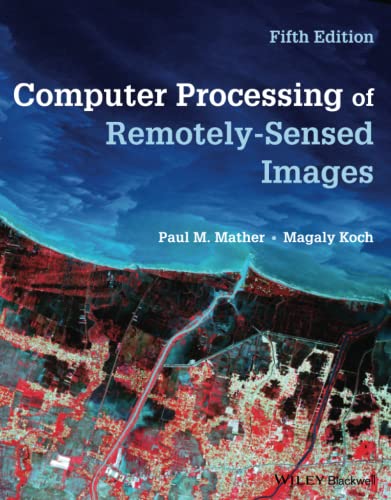
Computer processing of remotely-sensed images / Paul M. Mather, Magaly Koch.
Publisher: Hoboken, NJ : Wiley-Blackwell, 2022Copyright date: 2022 Hoboken, NJ : Wiley-Blackwell,Edition: Fifth editionDescription: xxii, 352p. illContent type:- text
- unmediated
- volume
- 9781119502821
- 621.36/78028566 23/eng20220225
- G70.4 .M38 2022
| Item type | Current library | Call number | Status | Date due | Barcode | Item holds | |
|---|---|---|---|---|---|---|---|
 Books
Books
|
NILE UNIVERSITY OF NIGERIA - MAIN LIBRARY | G 70.4 .M38 2022 (Browse shelf(Opens below)) | Available | 0199641 |
Includes bibliographical references and index.
Includes bibliographical references and index.
"This book is concerned with methods of input, computer processing and output of digital EO data. It is technique-oriented, so that questions such as 'how do I do that?' take precedence over subject-matter oriented ('what does that result mean?'). Naturally, it is impossible to answer the technique-oriented questions without some considerable appreciation of the meaning of the data that is being processed, and vice-versa. The authors therefore assume that a course based on this book is augmented by further courses that deal with applications. These courses can run simultaneously or sequentially. Bringing in real data describing substantial examples is important when teaching practical methodology so that the student experiences the difficulties of experimental design and comprehension of program documentation as well as the morale-reducing moments when it is realised that the technique has not provided the required answers"-- Provided by publisher.
There are no comments on this title.